
Freedom app features
Health Checkpoints, Wellbeing & PHQ-4 in Freedom App
Health checkpoints are time-based reminders to revisit topics after your last drink. Freedom app keeps this educational timeline alongside a daily wellbeing record and PHQ-4 symptom screening, so you can distinguish elapsed time from how you report feeling.
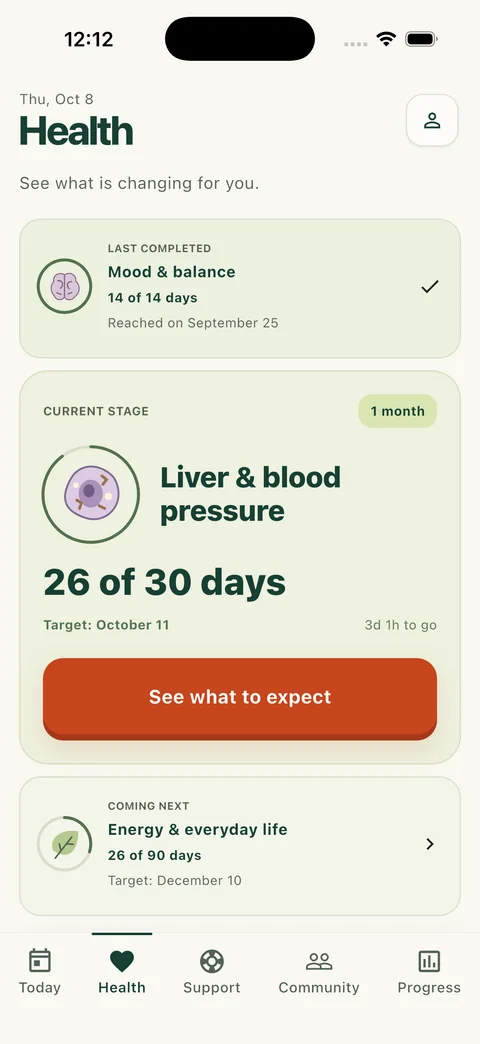
What is the Health feature?
Stop Drinking Alcohol: Freedom is an iOS and Android app by SK LABS. Its Health tab brings together twelve educational checkpoints, a 14-day wellbeing chart and saved PHQ-4 assessments with a 90-day chart.
Three records, three different questions
The timeline, daily check-in and questionnaire serve different purposes. Read each one on its own terms rather than combining them into a single recovery score.
For example, you might reach the day-seven checkpoint and mark today as Tough. Both entries can be accurate: one describes elapsed time, and the other describes today. A PHQ-4 result covers symptoms over the past two weeks, so it answers a longer-term question.
Scroll horizontally to compare all columns.
| Record | Question it answers | Time period |
|---|---|---|
| Health checkpoint | How much time has passed toward this educational checkpoint? | From your recorded last-drink date. |
| Daily wellbeing | How did this day feel: Tough, Okay or Great? | A daily entry displayed in a 14-day chart. |
| PHQ-4 | How often did anxiety and low-mood symptoms bother me? | The previous two weeks, with results displayed in a 90-day chart. |
See what each health checkpoint means
Twelve checkpoints organize topics to revisit after stopping alcohol. The Health screen shows the previous, current and next checkpoint, with a target date and the time elapsed toward it. Open a checkpoint to read its explanation and sources.
The timeline uses the same last-alcohol date as the Today counter. For example, the day-three hangxiety checkpoint introduces anxiety after drinking. It does not say that anxiety will disappear in three days. Recording a later drink moves the timeline’s starting point; undoing that entry restores the previous period.
A progress ring measures time toward a review date. It cannot tell you how much your liver, sleep or nervous system has recovered.
Record how the day felt
Choose Tough, Okay or Great in the optional daily wellbeing check-in. Health displays these entries over 14 days so you can compare recent days without relying entirely on memory. You can add, edit or delete past entries.
A missing entry stays a gap. The app does not invent a score for that day or turn your choice into a medical measurement. Earlier records of sleep, energy and mood remain separate from the current daily wellbeing series.
Use a validated four-question screening tool
PHQ-4 is a four-question screening questionnaire about anxiety and low-mood symptoms over the past two weeks. Four answers produce a total from 0 to 12, with separate anxiety and depressive-symptom subscales. Original research evaluated the instrument in primary care and the general population.
Freedom saves your results, shows a 90-day chart and lets you open individual assessments. Comparisons use an earlier result with the same questionnaire version and language. Repeating the check sooner than two weeks means the reporting periods overlap.
After completing the questionnaire, you can review your total, both symptom subscales and an explanation of the result. The result also includes brief practical suggestions and guidance on when to seek a fuller assessment from a doctor or mental-health professional.
PHQ-4 is a screening questionnaire, not a diagnosis. A change in score describes a change in reported symptoms; it does not establish that the app caused an improvement. Discuss persistent or concerning symptoms with a qualified health professional.
Keep personal records distinct from app milestones
Wellbeing entries and questionnaire results are stored with your app account. They are personal records rather than community posts. Checkpoint dates, daily entries and PHQ-4 scores each answer a different question, so the app keeps their meanings separate.
Health tracking sits alongside the sobriety counter, savings estimates and coping exercises. It does not replace medical assessment or manage alcohol withdrawal.
Key takeaways
- Use checkpoints to revisit educational topics as time passes. The progress ring measures time, not organ recovery.
- Record Tough, Okay or Great to keep a daily wellbeing history you can correct later.
- Use PHQ-4 to record symptoms over two weeks and read the result explanation. Screening can inform a conversation with a professional; it does not provide a diagnosis.
Health Checkpoints FAQ
Does a completed checkpoint mean my body has recovered?
No. It means the checkpoint’s time interval has elapsed. The educational timeline does not measure organ function or predict when an individual symptom will resolve.
Can PHQ-4 diagnose anxiety or depression?
No. PHQ-4 is a validated screening instrument that can indicate symptoms worth discussing with a professional. Freedom does not provide a diagnosis.
Can I correct a wellbeing entry?
Yes. You can review, add, edit and delete daily wellbeing entries. Missing days remain visible as gaps rather than estimated answers.
What happens to Health when I record alcohol?
A later recorded last-drink time becomes the timeline’s new starting point. Your saved wellbeing entries and PHQ-4 results remain in their histories.
What happens after I complete PHQ-4 in Freedom app?
You see your total score, the anxiety and depressive-symptom subscales, an explanation and practical next steps. The assessment is saved in your history. Where a compatible earlier result exists, the app also shows the difference in reported symptom scores.
Can I record a difficult day after reaching a health checkpoint?
Yes. Daily wellbeing and checkpoint progress are separate. Reaching a date does not require you to feel better, and choosing Tough does not change the amount of time since your last drink.
Sources & further reading
- Kroenke et al. (2009): An ultra-brief screening scale for anxiety and depression: the PHQ-4Psychosomatics / PubMed · Checked
- Löwe et al. (2010): Validation and standardization of the PHQ-4 in the general populationJournal of Affective Disorders / PubMed · Checked
Get the Freedom app
Keep a record of how you feel, revisit health topics and see your saved questionnaire results in one place.