
Freedom app features
CBT-Informed Habit Lessons for Alcohol Routines
CBT-informed habit lessons are educational exercises that help you connect a drinking situation with what you expect from alcohol and an action you could take instead. Freedom app guides you through short choices and a private reflection you can revisit.
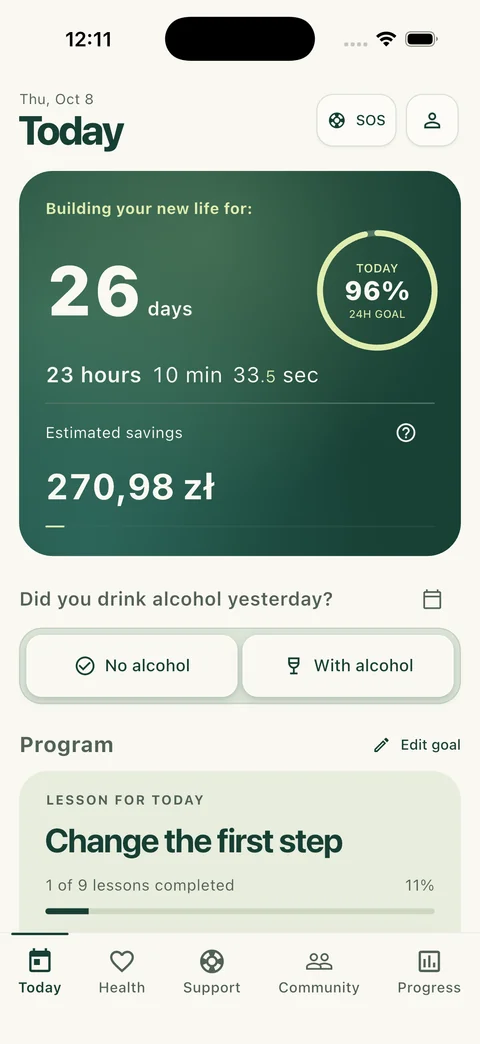
Habit lessons in Freedom app
Stop Drinking Alcohol: Freedom is an iOS and Android app by SK LABS. Its first two habit lessons focus on identifying a drinking trigger and changing an early step in a familiar routine.
What CBT-informed means here
Cognitive behavioral therapy (CBT) examines connections between situations, thoughts and behavior. Freedom’s current lessons use a narrower set of educational activities: noticing a drinking cue, identifying what you expect alcohol to provide and choosing another response.
NIAAA’s alcohol-craving worksheet describes recognizing triggers, avoiding some situations and preparing coping strategies as an approach commonly used in CBT. That overlap is why we describe these exercises as CBT-informed. It does not make Freedom a complete CBT treatment program or establish clinical effectiveness for the app.
Sources & further reading [1]
Identify the situation and what you expect
The first lesson, “What makes you want a drink?”, asks you to select a familiar situation and the benefit you expect from alcohol. Examples include finishing work, being at home or spending time with other people.
If you choose finishing work and wanting a reward, the exercise helps separate that moment from the drink itself. Its summary reflects your selected answers and suggests considering another reward, such as a meal, music or time for a hobby.
You complete two short selections and can add a personal note of up to 160 characters. The lesson includes an explanation, an example and sources, rather than only a prompt to write.
Choose an earlier point to act
The second lesson, “Change the first step”, looks at what happens before the first sip. You identify an early cue, such as arriving home, opening the fridge or being offered a drink, then select a different action.
For example, arriving home could become a cue to put the kettle on before opening the fridge. The aim is to prepare one recognizable action for one familiar moment. The resulting takeaway uses your choices and remains available to revisit.
Scroll horizontally to compare all columns.
| Part of the routine | Example to think through |
|---|---|
| Situation | Arriving home after work. |
| Expected benefit | A reward or a way to mark the end of the working day. |
| Early cue | Opening the fridge before deciding what to do. |
| Alternative action | Put the kettle on first and decide what to eat. |
Find lessons on Today and keep notes private
Open the program on Today, below the daily check-in. The featured lesson lets you begin or return to an exercise, and the list shows completion and availability. Start with identifying a drinking trigger, then explore how to change the first step in a familiar routine.
After you complete the first lesson, the second becomes available on the following day in your program’s timezone. You can revisit a completed lesson while waiting; the pause is based on the next local day, not a rolling 24-hour timer.
Each completed lesson can be repeated with a fresh draft. Your earlier completion stays recorded, and a new summary replaces the previous one only after you finish again.
Exercise answers and optional notes stay on your device. Completion metadata syncs to your account. These are different storage rules: a private local note is not a cloud-backed journal or a message to a mentor.
Key takeaways
- Start with one familiar situation and the benefit you expect from drinking.
- Choose an early cue and a different action you can prepare before the first sip.
- Return to a finished lesson when your routine changes. Your answers and notes remain on your device; lesson completion syncs to your account.
CBT Habit Education FAQ
Are these lessons the same as CBT therapy?
No. They are educational exercises informed by trigger recognition and coping approaches used in CBT. They do not provide assessment, individual therapy or a complete treatment program.
What do the first two lessons cover?
The first lesson helps you identify a familiar drinking situation and what you expect from alcohol. The second focuses on an early cue in that routine and another action you can prepare. Both include an explanation, example and structured exercise.
Can I repeat an exercise when my routine changes?
Yes. Repeat either finished lesson to make a new draft. Your previous completion stays recorded, and the saved takeaway changes after you complete the new exercise.
Can a mentor read my lesson notes?
Lesson answers and notes stay on your device. Optional context sharing in mentor chat includes your goal and program progress, not these private exercise notes.
When can I open the second habit lesson?
Complete the first lesson, then return on the following day in your program’s timezone. The app shows lesson availability on Today. Completed lessons stay available to revisit.
How do habit lessons differ from craving tools?
Habit lessons help you examine a familiar drinking situation and prepare another response. Craving tools provide an activity to follow in the moment, such as breathing, grounding or an untimed number game. You can use a lesson to plan ahead and Support when you want an activity now.
Sources & further reading
- How to Stop Alcohol Cravings: recognize, avoid and cope with triggersNational Institute on Alcohol Abuse and Alcoholism · Checked
Get the Freedom app
Explore short lessons, save your reflections and return to an exercise when your routine changes.